

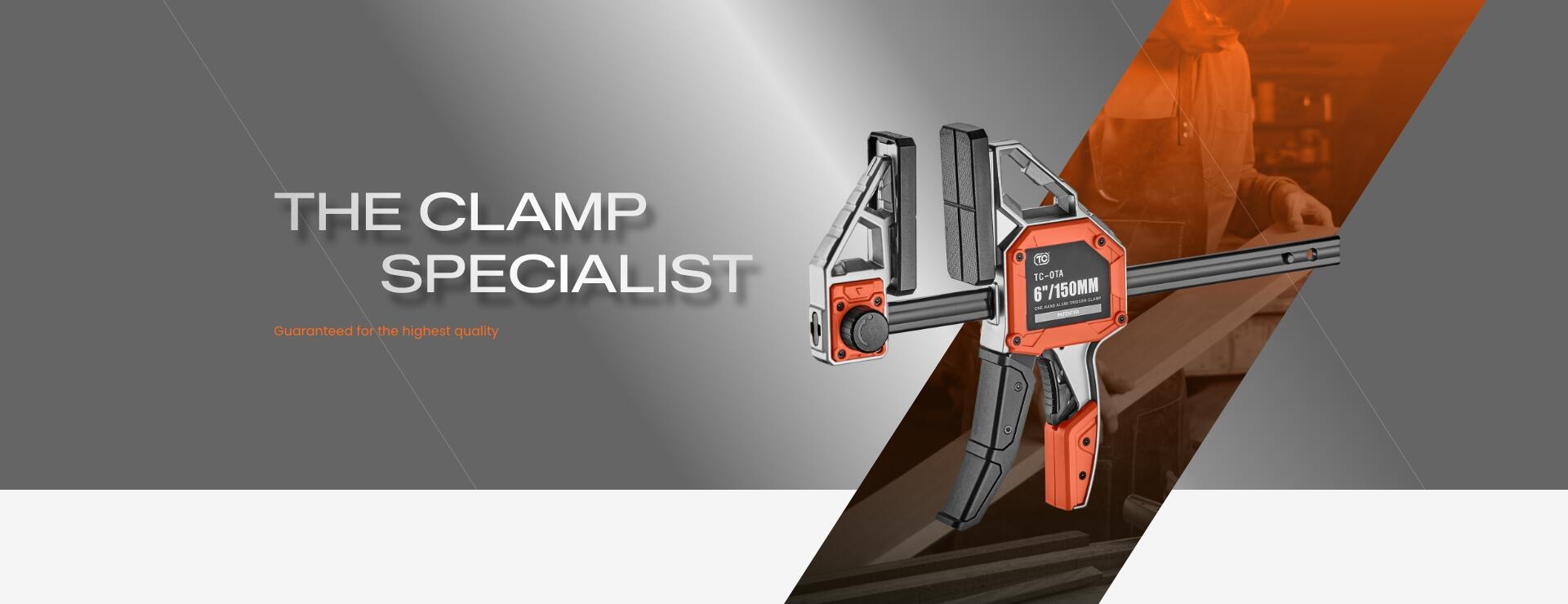

In woodworking, metalworking, and interior renovation, choosing the right clamp directly affects the outcome of work efficiency and the perfect finish of the final product, that everyone seeks. While all clamps serve the same fundamental purpose of holding workpieces, their mechanical designs, clamping forces, and contact areas create distinct, and unique applications for each.
TAI-CHING, as a clamping specialist, we have a quick guide to the 6 most common clamp types on the market to help you select the exact tool for your project requirements.
Top 6 Common Clamp Types & Key Features
1. Hand Clamps / One-Handed Clamps
Hand clamps are among the most common and budget-friendly options. Many consumers mistakenly confuse hand clamps with A clamp. It may be true but there is a distinct mechanical difference between the two. They generate clamping force differently: one relies on the spring energy, while the other utilizes a ratchet mechanism.
Spring Clamps (A-Clamps)
- Core Mechanism: A-frame nylon composite body fitted with a heavy-duty torsion spring.
- Key Features: Functions like a big binder clip—squeeze to open, release to clamp. Clamping force depends entirely on the torque of the spring.
- Best Applications: Single-handed operation for rapid, light-duty positioning of boards and sheets.
Ratchet Hand Clamps
- Core Mechanism: Scissor-style nylon composite body with a small-gauge torsion spring combined with a ratchet mechanism.
- Key Features: The small-gauge torsion spring enables a quick-release "opening" motion. Clamping force is adjustable; the harder you squeeze, the greater the force generated. Ratchet style hand clamps typically deliver up to twice the clamping force of a standard spring clamp.
- Best Applications: Single-handed operation where clamping force can be adjusted with the grip of the hand.
2. Quick Clamps/ Bar Clamps
- Core Mechanism: Engineered with multi-component locking mechanisms along a steel bar to achieve instantaneous clamping.
- Key Features: Delivers big and progressive clamping force with relatively minimal grip forces.
- Best Applications: Enable to generate relatively big clamp force via one hand. Clamp force also can be generated progressively with one hand.
3. F-Clamps & C-Clamps
- Core Mechanism: F-Clamps utilize a sliding arm on a steel bar paired with a threaded spindle; C-Clamps feature a heavy-duty, one-piece forged or cast rigid frame with a threaded spindle.
- Key Features: All-metal construction built for extreme durability. Offering the widest clamping capacity, they are the most widely used essential clamps in industrial and woodworking applications.
- Best Applications: General woodworking assembly, heavy-duty metalworking, welding positioning, and high-pressure clamping.
4. Pipe Clamps
- Core Mechanism: Comprised with a clamp body with thread spindle, and multi-piece clutch mechanism tailpiece designed to fit standard 1/2" (outer diameter 21.7mm) or 3/4" (outer diameter 27.2mm) pipes (black iron pipes is recommended).
- Key Features: Unlimited clamping length, achieving extra-large spans simply by extending pipe length.
- Best Applications: Large and extra-large panel gluing (Glued Panels), oversized structural framing.
5. Parallel Clamps
- Core Mechanism: Two large, perfectly perpendicular jaws mounted on a heavy-duty serrated steel bar and driven by a high-duty thread spindle.
- Key Features: Provides true 90-degree parallel pressure with extra-large clamp surfaces that distribute force evenly without marring workpieces.
- Best Applications: Best for medium-to-large panel gluing, box framing, and large-surface lamination.
6. Woodworking Vises
- Core Mechanism: A heavy-duty guide-rod and spindle mechanism mounted to the side or embedded into the workbench, paired with cast-iron or hardwood jaws.
- Key Features: Fixed directly to the workbench to provide ultimate stability, delivering the highest clamping force among all clamp categories.
- Best Applications: Hand planning, chiseling, sawing, dovetail joinery, and edge finishing.
Quick Comparison
| Clamp Type | Operation / Mechanism | Core Advantage | Ideal Applications |
|---|---|---|---|
| Hand Clamp | Squeeze grip | Easy one-handed operation | Light-to-medium woodworking, quick positioning |
| Bar Clamp | Multi-component locking mechanisms | Easy to operate, instant locking, versatile capacity | Multi-purpose tasks & job sites |
| F-Clamp / C-Clamp | Sliding arm/rigid frame + threaded spindle | Large capacity, high rigidity, extreme durability | General woodworking, welding, and heavy machining |
| Pipe Clamp | Threaded spindle + steel pipe | Infinite length expansion, highly cost-effective | Large to extra-large panel gluing & timber framing |
| Parallel Clamp | Threaded spindle (90° parallel force) | 90° parallel jaws, uniform force, non-marring | Medium-to-large panel gluing, box & cabinet assembly |
| Woodworking Vise | Bench-mounted / guide rod & spindle | Ultimate stability, frees hands for precision work | Hand planning, sawing, dovetail joinery |
Conclusion
When navigating diverse processing scenarios, choosing the right clamp based on your specific workpiece requirements and working environment is the key to maximizing efficiency while preventing damage to both your tools and workpieces. Understanding the distinct properties of each clamp type ensures a smoother, more efficient crafting and construction process!
If you have any questions or need further assistance, please feel free to Contact Us. We are always here to help!